
Over the last year or so, Google’s AI Overviews (AIO) feature and the new experimental AI Mode have been massively shaking up how search works… and that’s putting it mildly.
These features are changing how users engage with search, how your website and content appear in search results, and how you need to adapt your SEO strategy.
If you want your site to stay visible in search results, you need to understand how to rank in AI Overviews by building a strong SEO strategy focused on great content.
We’ve put together this detailed guide on Google’s AI Overviews, covering everything we know so far, and breaking down tips directly from Google on ranking in AI Overviews.
Let’s start with the basics… 👇
What are AI Overviews and AI Mode in Google Search?
What are AI Overviews?
AI Overviews are AI-generated summaries that answer more complex questions and queries with a quick, but detailed answer pulled from multiple sources.
Instead of just showing a list of links, Google uses a large language model (LLM) powered by Gemini 2.0 to generate a helpful overview right at the top of the results page.
You’ve probably come across them when searching on Google for things that need a bit more explanation, like comparisons and multi-step guides.
For example, searches like this will typically trigger an AI Overview:
- “What should I pack for a 10-day trip to Japan in March?”
- “What are the best CRM systems for small businesses?”
- “How to improve sleep quality”

Because these summaries appear above the usual search results, they take up a lot of the organic visibility. And because they aim to give users a complete, accurate answer, the user might not click through to your website even if your content is used.
That’s why learning how to rank in AI Overviews is quickly becoming a key part of SEO.
But Google has said that AI Overviews won’t show up for every single query, especially not for very basic queries where a more complex answer isn’t necessary.
So, if you want to rank in AI Overviews and grow your visibility, it’s important to do some keyword research.
Rollout of AI Overviews
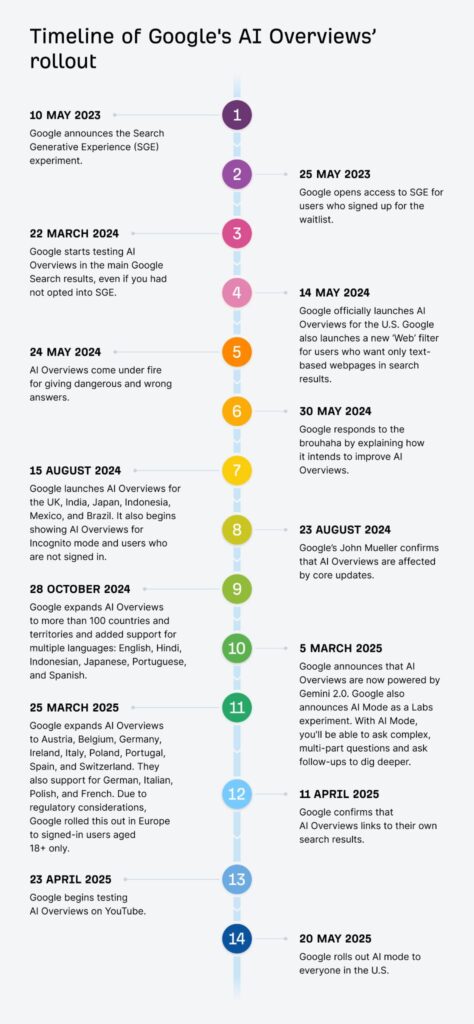
Google launched AI Overviews as an experimental feature in May 2023, but back then, it was called Search Generative Experience (SGE).
They initially only rolled it out to users who had signed up for the waitlist, and things were mostly quiet during the early tests.
In March 2024, people began noticing AI Overviews summaries appearing for a handful of terms as Google started testing in live search results.
By May 2024, AI Overviews had officially launched in the U.S. and were starting to appear more frequently in search results. After some initial teething issues (we’ll come to that later), Google began expanding the rollout globally.
Today, AI Overviews is powered by Gemini 2.0, a more powerful AI model, and is active in over 100 countries and multiple languages.
Here’s a complete timeline, created by Ahrefs, showing how the rollout unfolded:
Google’s new AI Mode
Recently, Google has also been testing a new search experience called AI Mode.
AI Mode’s system isn’t entirely new, as it’s powered by the same systems as AI Overviews. But this is a whole new way to search on Google, with a fully AI-powered interface instead of the usual Google search results.
AI Mode works very similarly to ChatGPT. There are no classic blue links; instead, it feels more like a conversation.
You ask a question, and Google replies in detail. You can keep asking follow-up questions to get deeper, more specific answers. AI Mode will also suggest follow-up prompts and related, helpful topics.

Over the last few months, AI Mode has been in testing in the U.S. and is slowly rolling out to more countries, including the UK, in August 2025.
With search moving into a more conversational space, zero-click searches are becoming increasingly common. Users now often engage with AI summarised answers before the organic search results.
That’s why ranking in AI Overviews and this new AI Mode is so important. There are fewer clicks to fight over, and more people are focusing on being seen and cited in AI Overviews.
You might not get the traffic, but you’ll still want to be seen in the answer!
Here’s more on how AI Overviews is changing SERPs 👇
How AI Overviews is changing Google Search results
AI Overviews has already had a massive impact on organic search.
The biggest effect is they’re pushing regular organic listings further down the page, especially on mobile, where the AIO box can take up most of the screen.
That means websites that previously ranked at the top are getting less visibility and traffic.
Plus, with people getting what they need without clicking through to any websites, Search Engine Journal reports that we’re seeing a big rise in zero-click searches, and it’s starting to cut into organic traffic across most sectors.
One study found that over 43% of AI Overview links point back to Google’s own sites, like YouTube, Maps, and Google Shopping. That’s a big deal if you rely on organic traffic to grow your business.
Industries like travel, health, and DIY are feeling it the most, but anyone who depends on search visibility should pay close attention if they want to rank in AI Overviews.
If you want your content to appear in the AI Overviews summaries, not just the links, you need to start thinking differently about SEO.
What Google recommends for AI Overview optimisation
In May, Google shared some advice on how to get your content into AI Overviews.
Their biggest tip? Focus on maintaining a solid SEO foundation on your website and creating helpful content that shows real expertise.
Google’s AI model is looking for content that:
- Is written clearly, with a logical structure
- Shows experience, authority, and trustworthiness (E-E-A-T)
- Answers the user’s question clearly and accurately
There’s no “secret formula” to ranking in AI Overviews.
If your site is optimised and your content is genuinely helpful and well-written, it has a greater chance of being featured.
Google also recommends using structured content formats, like FAQs, comparisons, and how-to guides, to help their systems understand your content.
Google’s guidance is a solid starting point if you’re aiming to rank in AI Overviews with consistent, quality content.
We help businesses structure their content for both traditional search and AI-powered SEO, using content strategies that align with how users search and how AI reads pages.
If you need help with your content strategy, get in touch with our SEO specialists.

Proven techniques to help you rank in AI Overviews
Focus on genuine, high-quality content
To quote a marketing cliché, content is king if you want to rank in AI Overviews.
Google’s AI systems are designed to reward genuinely helpful content written by people who understand the topic. That means surface-level answers or generic content written solely to rank on Google won’t cut it anymore.
To rank in AI Overviews, your content needs to:
- Go beyond the obvious, offer depth, nuance, and real-world experience
- Be written for real people first, not just to rank well on Google
- Use clear, direct language that matches the search intent
Google’s Helpful Content System prioritises pages written with the reader in mind. The same principle applies when aiming for visibility in AIO.
If you’re writing about something you have experience in, whether that’s running a business, using a product, or solving a specific problem, make that clear in your content. Add first-hand examples, data, and expert opinions and experiences.
Content that answers the why, not just the what, performs better in generative search. Don’t just say what a thing is. Say how it works, why it matters, and when it’s useful.
Use structured content hierarchies
Properly using heading tags (H1, H2, H3, etc.) is more important than ever.
LLMs process content differently from Google’s traditional crawlers. They rely heavily on the format of your content to figure out what each section, image, and link is about.
So, make sure you break your content into clear sections with descriptive headings in the correct hierarchy order, like this:
- H1: Blog Name / Page Title
- H2: Headings for each section
- H3: Headings for points under each main section
Keep your paragraphs short and digestible, optimise your images, and use your headings to guide your readers and make everything super easy for them (and Google’s AI) to understand.
Write like you’re answering a real question
AI Overviews tend to trigger more on question queries.
So, as you would expect, content that directly addresses and answers questions, like an FAQ page or a step-by-step guide, is more likely to be cited in AI Overviews.
So make sure you’re writing content that directly answers your audience’s questions in a genuinely helpful way.
Here are a few tips:
- Start by finding relevant questions that people are actively asking on Google
- Use those headings in your content title or section headings
- Answer in the clearest way possible
- Link to reliable, trusted external sources to back up your answers
- Use bullet points, numbering, and FAQ sections to increase chances of being cited
Answering questions directly in a clear and helpful way will improve user experience and increase your chances of ranking in AI Overviews for informational and long-tail queries.
Use schema markup
Structured data like FAQPage, HowTo, and Product schema helps Google’s crawlers understand your content. It won’t guarantee you a spot in AI Overviews, but it’s worth having for detailed guides, complex articles, and product pages.
If you’re unfamiliar with schema, think of it as a way to give notes to Google to help it understand the key points in your content and where to show it.
For example, most recipe pages will use schema to display things like cooking times, ratings, and ingredients directly in organic search results.
Like these ratings, cooking time, and image snippets here:

Google uses schema to understand your content better, and when creating answers in AI Overviews, it can use this data to add weight to your citations and increase your chances of ranking in AIO answers.
Optimise your internal links
Internal linking is vital for your SEO, and that goes for ranking in AI Overviews too.
LLMs look at your internal links to see how your pages connect and relate to each other.
Building strong content clusters and internally linking to related posts helps to show depth, not just surface-level coverage of a topic.
Websites that go deeper on a topic, rather than jumping from one idea or trend to the next, tend to perform better organically and in AI Overviews.
Build topic clusters and authority
If you want to rank in AI Overviews, your content has to cover your core topics in depth, not just scratch the surface.
AI Overviews will build its answers from reputable, authoritative sources. To build that authority on your website, you need to create detailed content clusters that cover every aspect of the main topics relevant to your business.
Let’s say you’re in the finance industry. Rather than just posting a few scattered blogs on saving tips, you can break them into clusters like this:
- Cluster 1: Getting started with saving
- Cluster 2: Saving for specific goals
- Cluster 3: Saving by life stages
- Cluster 4: Saving vs. investing
- Cluster 5: Psychological factors in saving
- Cluster 6: Digital saving tools
Each cluster should have multiple articles underneath it, covering every possible topic angle.
The goal is to show Google you’re a genuine expert, not just publishing content for clicks and SEO gains.
Get talked about in the right places
Google isn’t just looking at your backlinks to judge your website authority anymore.
It’s picking up on everywhere your brand gets mentioned.
That means digital PR, getting quoted in articles and news stories, and sharing valuable insights on platforms where your audience hangs out is now super important.
This article from Search Engine Journal explains how visibility beyond the search results page is becoming more important for SEO.
Current limitations of AI Overviews
When AI Overviews was first introduced, there were a few teething issues.
There were viral moments like AIO telling people to glue toppings to pizza, drink urine to stay hydrated, and that Haggis is a Scottish animal with two legs shorter on one side than the other.
Thankfully, with Google constantly tweaking the system, glaring inaccuracies like that are less common now.
But still, it’s not all smooth sailing, and AI Overviews still has some fundamental gaps.
Sometimes AIO gets things wrong
We all know that AI-generated answers aren’t always accurate.
I’ve already mentioned a few crazy and inaccurate answers above, but there are some less obvious examples.
So, I ran a little test.
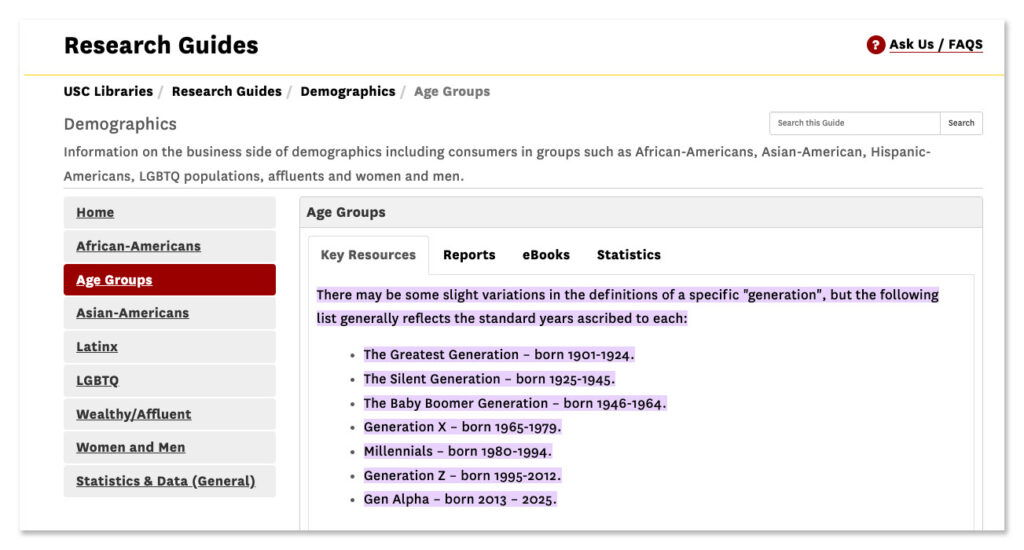
People always talk about Gen Z, Gen X and Millennials, but I wanted to know what Generation H was, and here’s what AI Overviews told me…

The problem is, Generation H doesn’t exist. I made it up.
But the way AI Overviews is programmed, it always aims to give a helpful answer rather than correct you. And in this case, it just fabricated information to give me an answer to my question.
Even when I clicked the sources links it provided, Generation H isn’t mentioned at all.
That’s the risk of relying on LLMs. They’re powerful, but not perfect.
No AIO tracking in Google Search Console
Currently, there aren’t any specific tools for tracking AI Overviews visibility in Google Search Console.
This makes it difficult to track which terms you are ranking in AI Overviews for and how many impressions and clicks you’re getting.
However, it does look like they’re on the way, with Google bringing AI Mode traffic data to GSC as the new search experience rolls out.
Until these tools reach us in the UK, you will have to rely on third-party tools or manual checks.
AIO answers are constantly changing
Even if your content gets cited today, it might be gone tomorrow.
AI Overviews results are dynamic, and they constantly change.
The same query can show different summarised answers even if the searches are just minutes apart.
Like this one below. I searched for “what’s the best laptop under £1,000 for video editing?” and got two different AI Overview results just 30 seconds apart.


Should you adapt your SEO strategy to focus on AI Overviews?
As zero-click search becomes increasingly common, you should definitely be looking to adapt your SEO strategy to focus on AI Overviews.
But that doesn’t mean you should scrap everything and focus on ‘GEO’ or ‘AEO’ or whatever else people are starting to call it.
It’s still just SEO. As Google has said, there are no tricks, hacks, or secrets to ranking in AI Overviews—just well-optimised websites and genuinely helpful content.
You need to prioritise nailing the fundamentals for SEO before anything else.
Your site needs to load fast, offer a great user experience, and follow Google’s best practices and guidelines.
Once you’ve nailed those areas, you should focus on scaling your content.
A good place to start with your content is:
- Writing clear and helpful content for real people
- Showing real expertise and authority
- Thinking about why someone is asking a question in the first place

What to expect from Google’s AI in the next year
Google’s AI Overviews and AI Mode are constantly growing and changing, and it’s just the beginning.
Over the next 12 months, you can expect:
- A wider rollout of AI Mode in more countries
- Better analytical tools to track AIO performance
- More AI tools showing up in different corners of the search world
Businesses that adapt now will have a better chance of ranking in AI Overviews and staying ahead of the curve as new tools and features are rolled out.
Remember, to rank in AI Overviews, you must focus on nailing the fundamentals of great SEO and prioritise creating genuine, helpful content for real people, not search engines.
Looking for help with your SEO and content strategies?
Our SEO specialists can help you rank in AI Overviews by optimising your website’s performance, structure, and content quality through detailed content audits, full SEO strategy, and ongoing optimisations.
Want to learn more? Get in touch!